
Image By: (http://www.google.com/miami.edu)
Due to their large, gentle slopes Mauna Loa and Kilauea compose much of the island. The gentle slopes are formed because the lava flow is very fluid, or has low viscosity, and can spread out for miles and miles around the volcano. The lava does not build up on itself due to the fact that it flows at a low angle. The lava does not only come out of the top of the volcano, but can also can escape through cracks or fissures all around the fractured volcano (Casey Allen, 2012). Mauna Loa and Kilaeua are shield volcanos, which makes them the least violent and dangerous type of volcano. They also fall under the category of mafic volcanoes, which means that they do not erupt or explode like other volcanoes do.

This is a photo of Mauna Loa taken from Kilauea ( http://dan-spencer.blogspot.com/2011/12/hawaii-thanksgiving-with-pele-at.html)
Both Mauna Loa and Kilauea are active volcanos, in fact Mauna Loa is the largest active volcano in the world! (http://hvo.wr.usgs.gov/maunaloa/). Being shield vocanoes, their eruptions are not as dramatic as other types of volcanoes eruptions can be. They do not produce large amounts of ash (tephra) nor do they produce volcanic bombs. Volcanic bombs are molten rock that is ejected during an eruption and cools into a solid object before it hits the ground (http://en.wikipedia.org/wiki/Volcanic_bomb). Shield volcanoes can produce spatter (molten rock that can be ejected from a volcano vertically) when erupting which can can be dangerous.
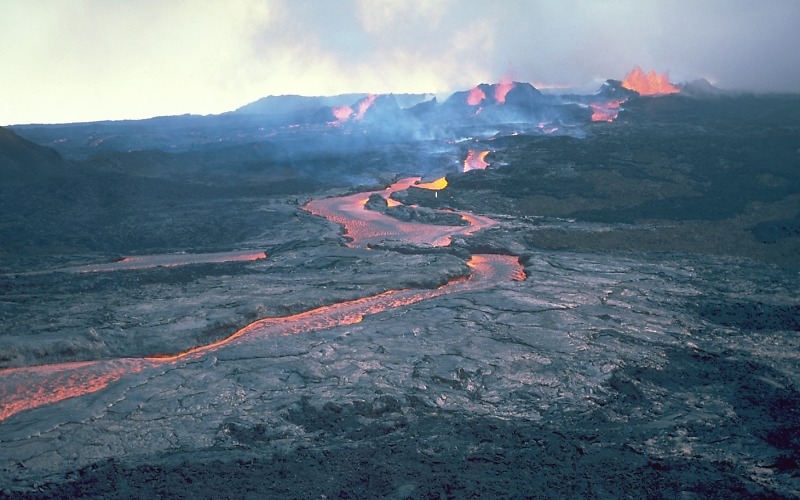
Lava flow and spatter in background. Image by: http://en.wikipedia.org/wiki/File:Aa_channel_flow_from_Mauna_Loa.jpg
http://www.youtube.com/watch?v=zLmjaFu3tus
(Follow the above link for footage of Mauna Loa erupting in the 1940s)
Shield volcanoes are known for their extensive lava tubes which are formed when the outside of a flow cools first and the inside keeps moving, which leaves a cave behind once the lava has run its course. The lava tubes are essential when forming a massive shield volcano because they allow the lava inside to flow without much cooling. Therefore the lava can spread for miles away from the center of the volcano (http://volcanoes.usgs.gov/images/pglossary/ShieldVolcano.php). People that visit the Big Island can go and explore massive lava tubes in Hawaii Volcanoes National Park that were formed 500 years ago when the lava stopped flowing through the tubes and flowed down hill (http://www.gohawaii.com/big-island/regions-neighborhoods/kau/nahuku-thurston-lava-tube).

Inside of the Thurston Lava Tubes in Hawaii Volcanoes National Park. Image by: http://www.adventure-caves-usa.com/images/cave_types_lava_caves.jpg


No comments:
Post a Comment