Wednesday, February 29, 2012

Mass Wasting on the Big Island

Mass wasting, or the downward movement of mass due to gravity, streams, mudslides, etc, can be seen throughout the big island.  Although there are numerous mass wasting events that can occur all over the landscape, rock falls and rock slides are common due to the fact that steep slopes and cliffs are abundant all over Hawai'i.

Major Rock Slide Just North of Pali Kaholo


http://0.tqn.com/d/gohawaii/1/0/7/G/4/hula_kai_013.jpg

This rock slide occured just north of Pali Kaholo on the big island.  It is classified as a rotational slump slide because of the curved plane of failure.  This means that rather than rock falling down a flat plane, the ground literally "slumped" down.  Think of a student slumping in a boring class after 10 minutes. A rotational slump differs from a translational slide due to the fact that the end result will look like a curve instead of a straight line that a translational slide will produce.  Translational slides occur when there is a flat plane line of failure and debris literally SLIDES down a slope. In order to show the difference between a rotational slump and translational slide pictures are provided below. 


http://clasfaculty.ucdenver.edu/callen/1202/Battle/Destroy/MassWasting/SlumpDiagramX.jpg (Slump)
http://clasfaculty.ucdenver.edu/callen/1202/Battle/Destroy/MassWasting/rockslidebasicAfter.GIF (Slide)

More rock slides around the big island...

http://hvo.wr.usgs.gov/kilauea/update/archive/2006/Oct/IMG_3056.jpg

(The picture above shows a translational rock slide because of the flat plane that the rocks slipped down into the ocean)


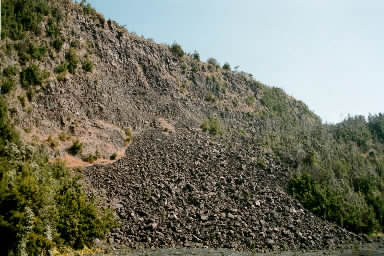
Another mass wasting event that is common on the big island are rock falls. A rock fall occurs when there is detachment from a steep slope from events like erosion.  Once the rock (or rocks) is completely detached from a side of the slope it falls due to gravity. The rocks that fall can range in sizes from very small pebbles to very large boulders. Rock fall produces talus, or the pile of rock found at the bottom.  Once the talus accumulates it forms talus cones.  The picture below shows a talus cone at the base of the Kilauea Caldera.  The cone shape of the talus is very clear.

http://community.middlebury.edu/~jmunroe/hawaii_03_1_files/image002.jpg

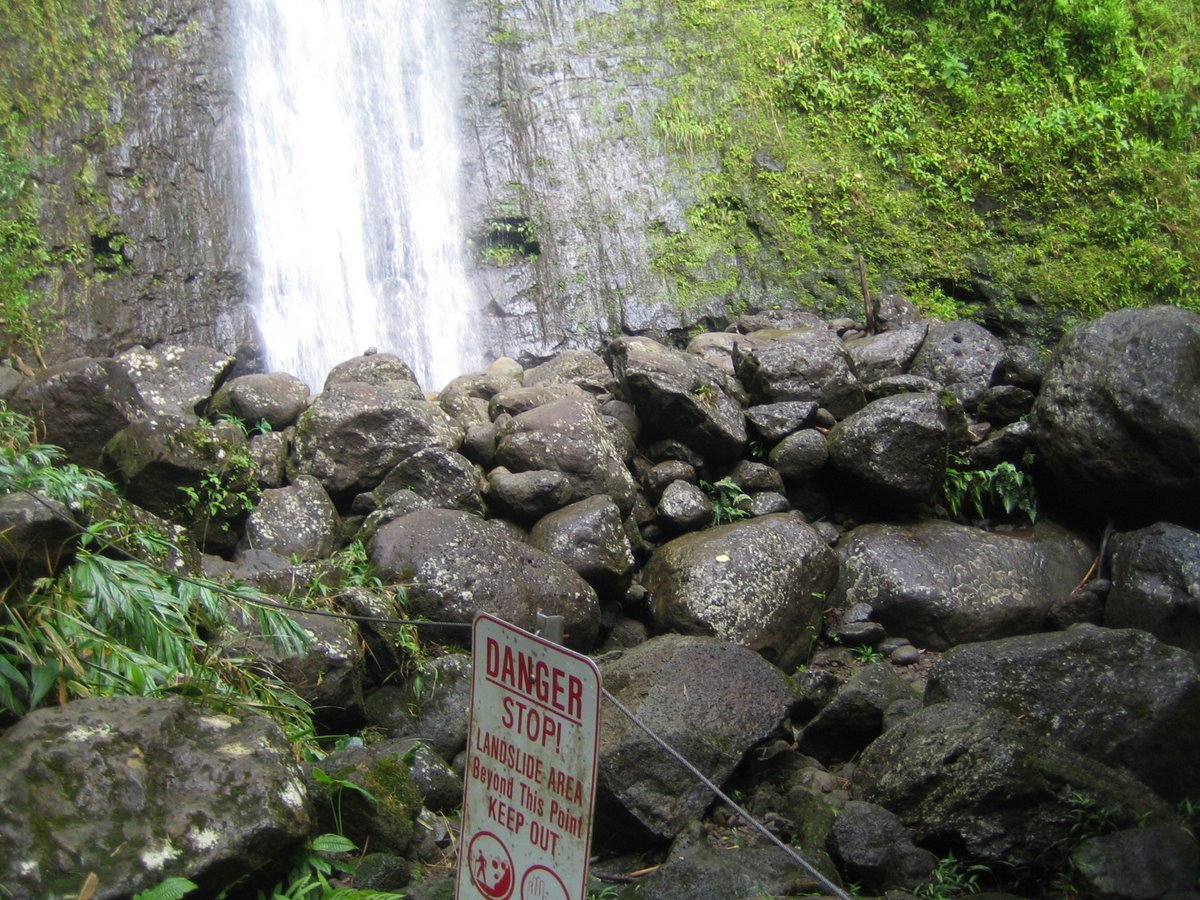
On the big island rock falls are common around waterfalls.  Waterfalls create the perfect atmosphere for rock falls with very steep cliffs and water flow that erodes away at the rock underneath it. People who visit the waterfalls need to be careful when there is evidence of rock fall and not get too close to avoid the risk of being hit.

http://www.fmschmitt.com/travels/Hawaii/Oahu-Manoa-Falls/20070111_hawaii_oahu_manoa_falls_trail_071.JPG


http://farm3.static.flickr.com/2279/2335828796_531894ee03.

Tuesday, February 7, 2012

If there is one thing the Big Island of Hawai'i is famous for, it is the volcanoes that have created it.  The Big Island has numerous volcanoes, however I will focus on Mauna Loa and Kilauea.


Image By: (http://www.google.com/miami.edu)

Due to their large, gentle slopes Mauna Loa and Kilauea compose much of the island.  The gentle slopes are formed because the lava flow is very fluid, or has low viscosity, and can spread out for miles and miles around the volcano.  The lava does not build up on itself due to the fact that it flows at a low angle.  The lava does not only come out of the top of the volcano, but can also can escape through cracks or fissures  all around the fractured volcano (Casey Allen, 2012).  Mauna Loa and Kilaeua are shield volcanos, which makes them the least violent and dangerous type of volcano.  They also fall under the category of mafic volcanoes, which means that they do not erupt or explode like other volcanoes do.


This is a photo of Mauna Loa taken from Kilauea ( http://dan-spencer.blogspot.com/2011/12/hawaii-thanksgiving-with-pele-at.html)

Both Mauna Loa and Kilauea are active volcanos, in fact Mauna Loa is the largest active volcano in the world! (http://hvo.wr.usgs.gov/maunaloa/).  Being shield vocanoes, their eruptions are not as dramatic as other types of volcanoes eruptions can be.  They do not produce large amounts of ash (tephra) nor do they produce volcanic bombs.  Volcanic bombs are molten rock that is ejected during an eruption and cools into a solid object before it hits the ground (http://en.wikipedia.org/wiki/Volcanic_bomb).  Shield volcanoes can produce spatter (molten rock that can be ejected from a volcano vertically) when erupting which can can be dangerous.

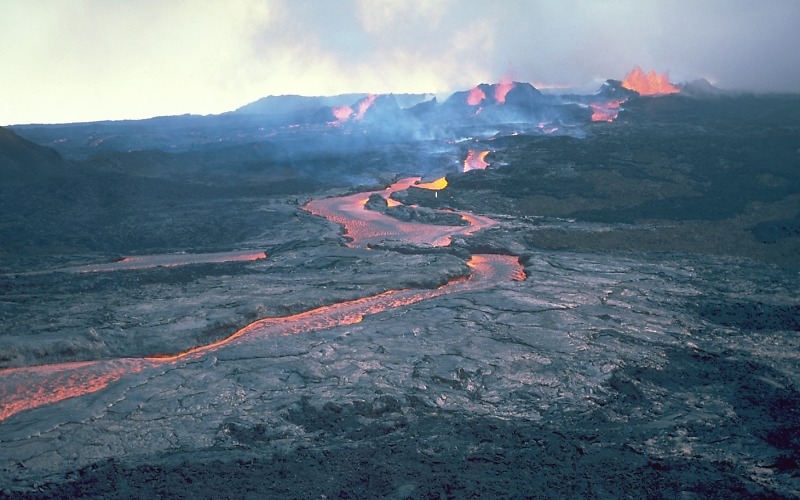
File:Aa channel flow from Mauna Loa.jpg
Lava flow and spatter in background.  Image by: http://en.wikipedia.org/wiki/File:Aa_channel_flow_from_Mauna_Loa.jpg


http://www.youtube.com/watch?v=zLmjaFu3tus

(Follow the above link for footage of Mauna Loa erupting in the 1940s)

Shield volcanoes are known for their extensive lava tubes which are formed when the outside of a flow cools first and the inside keeps moving, which leaves a cave behind once the lava has run its course. The lava tubes are essential when forming a massive shield volcano because they allow the lava inside to flow without much cooling.  Therefore the lava can spread for miles away from the center of the volcano (http://volcanoes.usgs.gov/images/pglossary/ShieldVolcano.php). People that visit the Big Island can go and explore massive lava tubes in Hawaii Volcanoes National Park that were formed 500 years ago when the lava stopped flowing through the tubes and flowed down hill (http://www.gohawaii.com/big-island/regions-neighborhoods/kau/nahuku-thurston-lava-tube).


Inside of the Thurston Lava Tubes in Hawaii Volcanoes National Park. Image by: http://www.adventure-caves-usa.com/images/cave_types_lava_caves.jpg